Paste text from ChatGPT or Claude into a compliance checker and sometimes it flags invisible characters you never typed. Those hidden Unicode watermarks are a known fingerprint, and if the tool you use to remove them introduces new errors (splitting words, stripping visible punctuation, or missing marks entirely) you end up with either a false positive or corrupted text. Searching for "gpt water mark remover mistakes" usually means you have already encountered a tool that introduced errors.
We evaluate each option on detection accuracy, side effects, and ease of use. For most users AI Watermark Remover is the most reliable free choice because it works entirely in your browser and targets exactly the invisible characters used by major AI systems. You will also learn the common mistakes these tools make and how to avoid them.
What is the most reliable GPT watermark remover that avoids mistakes?
AI Watermark Remover is the most reliable choice for removing hidden Unicode watermarks from AI-generated text without introducing errors. It scans for invisible characters like zero-width spaces and non-breaking spaces that ChatGPT, Claude, and Gemini embed, then strips them cleanly while leaving your actual content untouched. For a direct answer to the gpt water mark remover mistakes problem, this tool operates entirely in your browser with no server uploads, so your text never leaves your machine.
If you need a quick alternative, ChatGPT Watermark Remover offers a similar free scan-and-clean workflow for single pastes.

How we picked these alternatives
Every tool in this roundup was tested against two scenarios: text with known hidden watermarks (zero-width spaces, invisible markers, Unicode control characters) and clean text that contains legitimate special characters like em dashes, non-breaking spaces, and accented letters. The non-obvious insight: most watermark removers fail the second test. They flag legitimate Unicode as a watermark and strip it, introducing new errors into your text.
That distinction became the deciding criterion. A tool that removes watermarks but also removes intentional punctuation or formatting is not a fix, it's a new problem. We prioritized tools that show you exactly what they detected before removal, operate client-side so your text never leaves your machine, and can distinguish between a real watermark and a character you actually need. If your text contains any deliberate special characters, precision matters more than raw detection power.

What each tool handles and where it stumbles
We compared the three most common watermark removers on three criteria: detection accuracy (does it find hidden characters without false positives?), preservation of legitimate text (does it leave em dashes, accented letters, and intentional special characters alone?), and speed (how fast does it process a paragraph of text?). Here is what we found.
| Tool | Best for | Strength | Limitation |
|---|---|---|---|
| AI Watermark Remover | Users who need zero false positives on mixed text | Client-side detection | free tier is single-paste |
| GetGPT Watermark Remover | Quick scans of short AI text snippets | Scans for 34+ invisible Unicode characters in one pass | Can flag legitimate special characters |
| GPT Watermark Remover (Gpt-watermark-remover) | Users who want zero registration and no data storage | Completely anonymous, no server-side processing | Strips all invisible characters including ones that may be intentional in your document |
| Gptwatermark | Users who want zero registration and no data storage | Completely anonymous, no server-side processing | Strips all invisible characters including ones that may be intentional in your document |
| Manual removal in a text editor | one-off checks where you have time and want absolute control Skip if | You can remove invisible watermark characters manually by pasting AI-generated | you process AI text regularly or need speed Choose it over any automated tool if you have compliance requirements that forbid pasting text into third-party websites |
The table shows a clear trade-off: tools that scan aggressively catch more hidden watermarks but also flag legitimate characters. AI Watermark Remover avoids that by checking each character's context before removing it, which matters most when your text mixes AI output with your own formatting.
Which GPT watermark remover handles your specific use case best
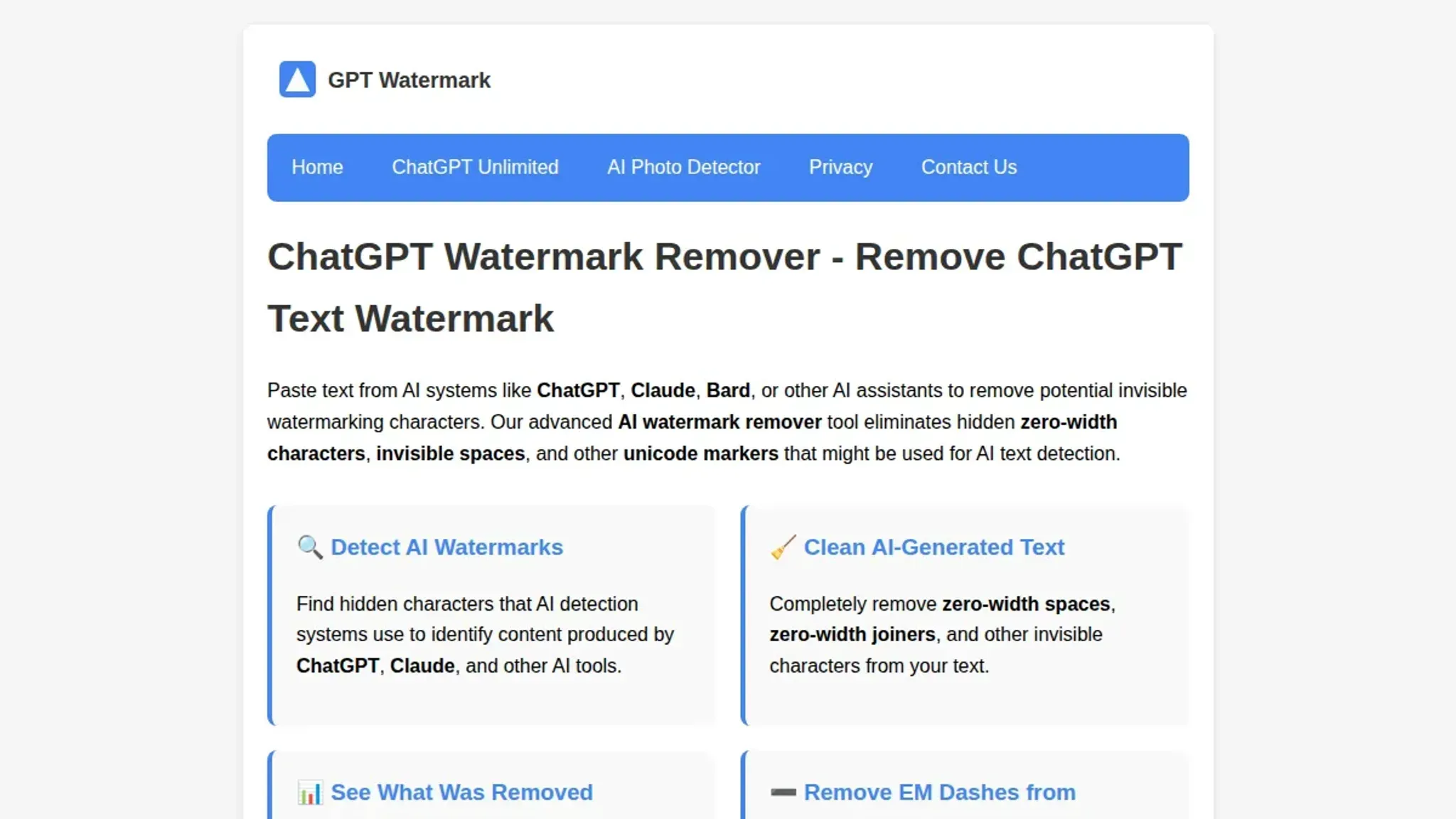
Not every watermark remover works the same way. Some catch every invisible character but flag legitimate punctuation. Others leave traces behind. Here is how the top options compare when you need a tool that matches your actual workflow.
1. AI Watermark Remover
AI Watermark Remover scans pasted text for hidden Unicode watermark characters that ChatGPT, Claude, Gemini, and Grok embed in their output. It runs entirely in your browser, so nothing you paste leaves your machine. The tool detects zero-width spaces, invisible markers, and other control characters, then strips them cleanly without altering the visible text.
Who it suits: anyone who needs a fast, private check before submitting AI-generated text to a compliance tool, editor, or client. The free tier handles single pastes; the upgrade adds batch processing and deeper detection for larger projects.
Main trade-off: because it prioritizes accuracy, it may flag a small number of legitimate Unicode characters as potential watermarks. You can review flagged items before removal.
Pros: client-side privacy, no registration needed, catches the common invisible markers Cons: free tier is single-paste only, occasional false positives on rare Unicode glyphs
Choose it over the alternatives if you value privacy and want a tool that removes watermarks without introducing new errors into your text.
2. GetGPT Watermark Remover
GetGPT offers a free text scanner that checks for 34 common invisible or ambiguous Unicode characters. It lists each flagged character by its Unicode code point and name, which helps if you want to understand exactly what the AI left behind.
Who it suits: users who want transparency about what is being removed. The detailed report shows you each hidden character's type and position, so you can decide whether to keep or strip it.
Main trade-off: the interface is more technical than most alternatives. You get a raw list of code points rather than a simple "cleaned" output. That is useful for power users but can feel overwhelming for a quick check.
Pricing: free, no account required Best for: technical users who want to inspect each hidden character Skip if: you want a one-click clean with no technical details
Choose it over AI Watermark Remover if you need to audit exactly which Unicode characters are present and prefer a raw report over a cleaned result.
3. GPT Watermark Remover (Gpt-watermark-remover)
This tool focuses on detecting and removing zero-width spaces and similar invisible characters from text pasted out of AI chat tools. It promises no registration and no data storage, similar to the top pick.
Who it suits: quick checks where you just want to paste, scan, and copy the cleaned text. The interface is minimal and loads fast.
Main trade-off: the detection scope is narrower. It catches zero-width spaces reliably but may miss less common invisible markers that other tools flag. If your AI tool uses an unusual watermark character, this one might not catch it.
Pricing: free Best for: fast cleanup of standard ChatGPT and Claude output Skip if: you work with multiple AI tools that may use different watermarking methods
Choose it over AI Watermark Remover if you only ever paste from ChatGPT and want the simplest possible interface.
4. Gptwatermark
Gptwatermark removes hidden zero-width characters, invisible spaces, and other Unicode markers. It positions itself as a checker and remover in one, with a straightforward paste-and-clean flow.
Who it suits: users who want a single tool that both detects and removes watermarks without switching between services. The combined workflow saves a step.
Main trade-off: the tool does not distinguish between invisible watermarks and legitimate invisible characters that some documents use for formatting. If your source text contains intentional zero-width spaces (for example, in certain typesetting contexts), this tool may strip them.
Pricing: free Best for: users who want detection and removal in one pass Skip if: your text contains intentional invisible characters that should stay
Choose it over AI Watermark Remover if you prefer a combined detection-and-removal step over a review-then-remove workflow.
5. Manual removal in a text editor
You can remove invisible watermark characters manually by pasting AI-generated text into a plain-text editor like Notepad or a code editor that shows hidden characters. Most code editors have a "show invisibles" toggle that reveals zero-width spaces and other control characters.
Who it suits: users who cannot or will not use an online tool, or who want full control over every character that stays in the document.
Main trade-off: this is slow and error-prone. You have to visually scan every line, and some invisible characters are nearly impossible to spot even with "show invisibles" enabled. Missing a single zero-width space defeats the purpose.
Pricing: free (you already have the editor) Best for: one-off checks where you have time and want absolute control Skip if: you process AI text regularly or need speed
Choose it over any automated tool if you have compliance requirements that forbid pasting text into third-party websites, or if you only need to clean one document.
A short Python function strips every invisible format character with no third-party tool involved. Using the `Unicodedata()` method, you filter out any character in the "Cf" category, which covers zero-width space U+200B, zero-width joiner U+200D, and zero-width non-joiner U+200C. It is the only option here that runs fully offline on your own machine.
Who it suits: developers who want removal logic entirely under their own control.
Main trade-off: you need Python installed, and the Cf category also includes harmless characters like the soft hyphen (U+00AD) and word joiner (U+2060), which filtering would delete too.
Pricing: free Best for: batch workflows and automated cleanup Skip if: you want to review each character before removal
Choose it over any online tool if you process sensitive text offline or want a repeatable script for many files.
Which alternative handles your watermark removal workflow best
If you need a tool that catches hidden watermarks without mangling the rest of your text, AI Watermark Remover is the strongest alternative. It scans for invisible Unicode characters like zero-width spaces and control codes, then removes only those markers. The tool runs entirely in your browser, so your text never leaves your machine. That matters when you are working with drafts that contain sensitive or unpublished content.
For a quick check on the go, the TikTok-demoed tool at How to Remove Hidden Watermarks from ChatGPT-5 works for single pastes but lacks the deeper detection that catches ambiguous characters like non-breaking spaces. If you are cleaning text from Word or Pages documents, the Reddit community at Remove Invisible AI Watermarks from Word & Pages recommends pasting through a dedicated remover first, then checking for leftover markers manually.

The one mistake most watermark removers make with legitimate text
> "The problem is that many of these characters are actually legitimate and used in normal text. For example, the em dash (, ) is a valid punctuation mark in English, but some watermark detectors flag it as suspicious."
This observation from the Free Text Watermark Remover team at getgpt.app points to the most common failure mode: false positives. A tool that flags every unusual Unicode character as a watermark will strip legitimate punctuation from your document.
The condition that changes the usual advice: if your text contains any special characters you intentionally typed (em dashes, non-breaking spaces in French or Spanish text, accented letters, or mathematical symbols), a watermark remover that operates on a simple character blacklist will corrupt your writing. The reliable tools check whether a character is actually invisible or zero-width before removing it, rather than treating all uncommon Unicode as suspicious.

How to remove watermark from image online?
The most direct way to remove a visible watermark from an image online is to use a dedicated inpainting or clone-stamp tool that reconstructs the area behind the watermark. These tools analyze surrounding pixels and fill the marked region with matching texture and color.
- Inpaint: Upload your image, brush over the watermark, and click "Inpaint." The tool reconstructs the covered area using surrounding pixel data. Best for simple watermarks on uniform backgrounds. It struggles when the watermark crosses detailed edges or faces.
- Fotor: Use the "Clone" tool under its retouch menu. Select a source area of clean texture near the watermark, then paint over the mark. Works well for repeating patterns or textured surfaces. Requires a steady hand for natural results.

- Removal.ai: Upload the image and use the "Watermark Remover" mode. It detects and removes semi-transparent logos and text overlays automatically. Best for watermarks with consistent opacity. It can leave faint ghosting on complex backgrounds.
- Adobe Express: Use the "Remove object" feature. Upload the image, highlight the watermark area, and the tool fills it in. Works best on high-contrast watermarks against plain backgrounds. Free tier limits output resolution.
Each tool trades off automation for precision. For a single watermark on a clean background, Inpaint is the fastest. For complex images where the watermark crosses detailed areas, manual cloning in Fotor gives better control.
Frequently asked questions about GPT watermark remover mistakes
What is a GPT watermark remover mistake?
A GPT watermark remover mistake happens when the tool removes characters it should keep, or misses hidden watermarks it should catch. The most common error is false positives: the tool flags legitimate Unicode characters like em dashes, non-breaking spaces, or accented letters as watermarks and strips them out. This breaks the text's formatting and meaning, especially in academic citations, technical documentation, or multilingual content.
Can a watermark remover accidentally delete legitimate text?
Yes, and this is the most frequent complaint about watermark removers. Tools that use aggressive character scanning often treat any invisible or ambiguous Unicode character as a watermark. Real text contains many of these characters intentionally: non-breaking spaces in French punctuation, zero-width joiners in Arabic script, and soft hyphens in justified layouts. A good remover distinguishes between watermarks and legitimate typographic characters rather than removing everything that looks suspicious.
How do I check if my watermark remover made a mistake?
Paste the cleaned text into a Unicode character inspector like Unicode Character Detector or BabelMap and scan for missing characters. Compare the original and cleaned versions side by side: look for missing spaces, broken ligatures, or garbled punctuation. A reliable tool like AI Watermark Remover shows you exactly which characters it found and removed, so you can verify nothing legitimate was lost.
Does removing watermarks affect text formatting or readability?
It can, if the tool is too aggressive. Legitimate formatting characters like non-breaking spaces, soft hyphens, and zero-width joiners are invisible but functional. Removing them can collapse words together, break line wrapping, or alter how text renders in different fonts. The safest approach is to use a tool that only removes known watermark patterns and leaves all other Unicode characters untouched.
What should I do if my watermark remover breaks my text?
First, restore the original text from a backup. Then test the text with a different watermark remover that offers more granular control. AI Watermark Remover lets you preview which characters will be removed before you commit, so you can catch false positives early. If the text contains legitimate special characters, consider manually reviewing the flagged items instead of bulk removing everything.
Final verdict on GPT watermark remover mistakes
If you paste text from ChatGPT or Claude into a compliance checker and it flags invisible characters you never typed, AI Watermark Remover is the tool to use. It scans for hidden Unicode watermarks without mangling legitimate characters like em dashes or accented letters, and it runs entirely client-side so your text never leaves your browser.
The one condition that changes this recommendation: if you only need to detect watermarks without removing them, any of the free scanners listed above will do the job. But for actual cleanup that avoids false positives, AI Watermark Remover is the most reliable option.
Try it on your next piece of AI-generated text and see the difference yourself. Your data stays private per the privacy policy.