How to Remove AI Watermark from Text Mistakes
How to remove AI watermark from text mistakes becomes a real problem when invisible characters like zero-width spaces and joiners sneak into your document. You pasted text from ChatGPT into a document and spent ten minutes hunting for a formatting glitch you can't see. The culprit is usually an invisible AI watermark: zero-width spaces, joiners, em dashes, and other hidden characters that ride along with generated text and break quotes, spacing, and detection checks.
Removing them is straightforward once you know what to look for.
Once you've seen a few examples, you'll be able to spot the most common AI watermark mistakes, strip them from ChatGPT, Claude, Gemini, and Grok output, and verify the text is clean. If you just want to know how to remove AI watermark from text mistakes, AI Watermark Remover removes every hidden character in your browser for free.
How do you remove AI watermarks from text mistakes?
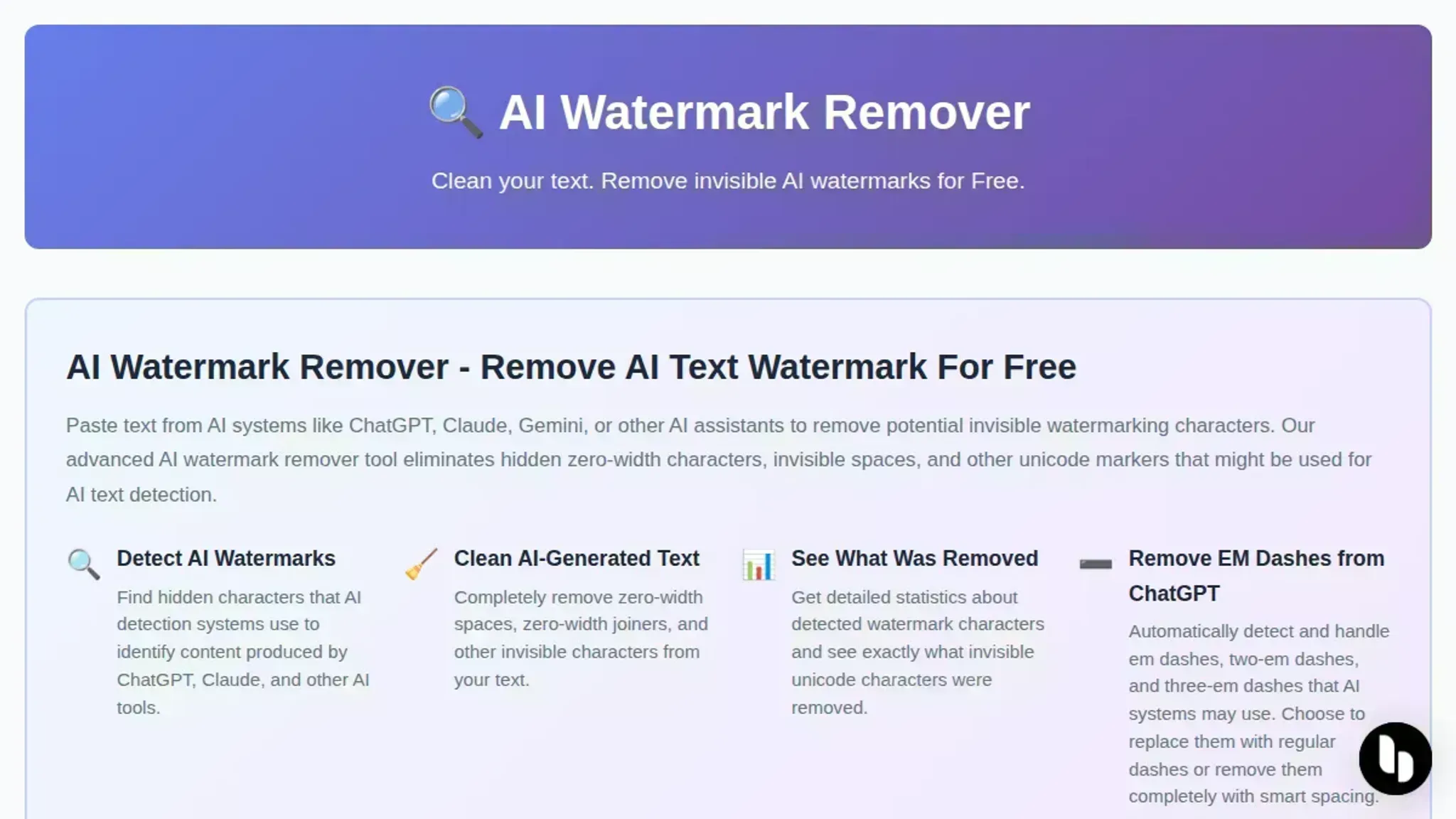
The most direct way to remove an AI watermark from text mistakes is a two-step pass: paste the text into a free browser-based cleaner like ai-watermarkremover.com to strip the invisible zero-width characters that ChatGPT and Claude hide in their output, then check whether a statistical watermark remains. Character cleanup fixes formatting glitches immediately, but it cannot erase the word-choice patterns that SynthID-style watermarks rely on.
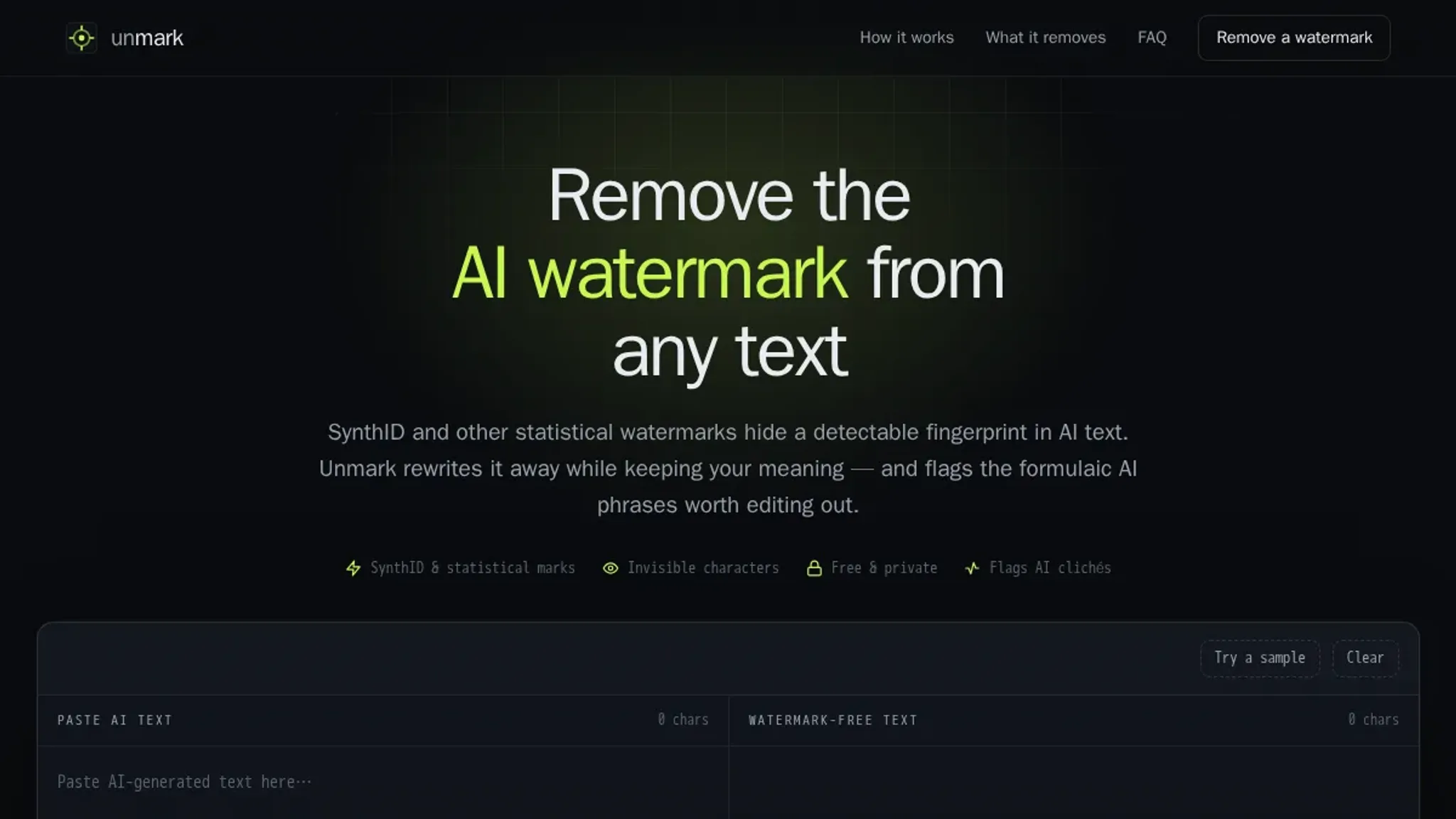
For those, run the cleaned text through Unmark, which rewrites watermarked phrasing while keeping your meaning.
What you need before removing AI text watermarks
You need the original AI text, a browser-based cleaner, and a realistic idea of which watermark type you are dealing with.
- The original, unformatted text. Copy it straight from ChatGPT, Claude, Gemini, or Grok before you reformat anything.
- A note on which model wrote the text. Some models embed only invisible characters; others add statistical patterns in word choice that a character cleaner cannot remove.
- A plain text editor for checking. Paste the cleaned output into Notepad to confirm the hidden characters are gone.
- A browser-based cleaner, AI Watermark Remover. It runs entirely in the browser, so nothing leaves your device.
The usual advice changes if you have already pasted the text into Word or Google Docs: the editor can strip invisible characters on its own, so a cleaner reporting zero removed characters is the expected result, not a failure.
Step-by-step workflow
Open your AI-generated text and read it once without editing. Mark every sentence that feels off, too symmetrical, too complete, or starting with the same transition word. The most common AI watermarks are:
- Repetitive sentence starters: "Furthermore," "Moreover," "In addition," "Additionally." If more than two sentences in a row begin with the same type of transition, that is a flag.
- Overly balanced structure: Every sentence has a subject, verb, and object in perfect order. Real human writing has fragments, run-ons, and clauses that trail off.
- Uniform paragraph length: Three to five sentences, each roughly the same length. Humans write one-sentence paragraphs for emphasis and seven-sentence paragraphs when they are on a roll.
- Missing contractions: AI tends to write "do not" instead of "don't," "cannot" instead of "can't," "it is" instead of "it's." This is the single easiest fix.
- Perfect parallelism: Lists where every item has the same grammatical structure. Humans mix "ing" verbs with "to" verbs and noun phrases without thinking about it.
I keep a checklist of these patterns taped to my monitor. After the first pass, I have usually flagged 60-70% of the text for edits.

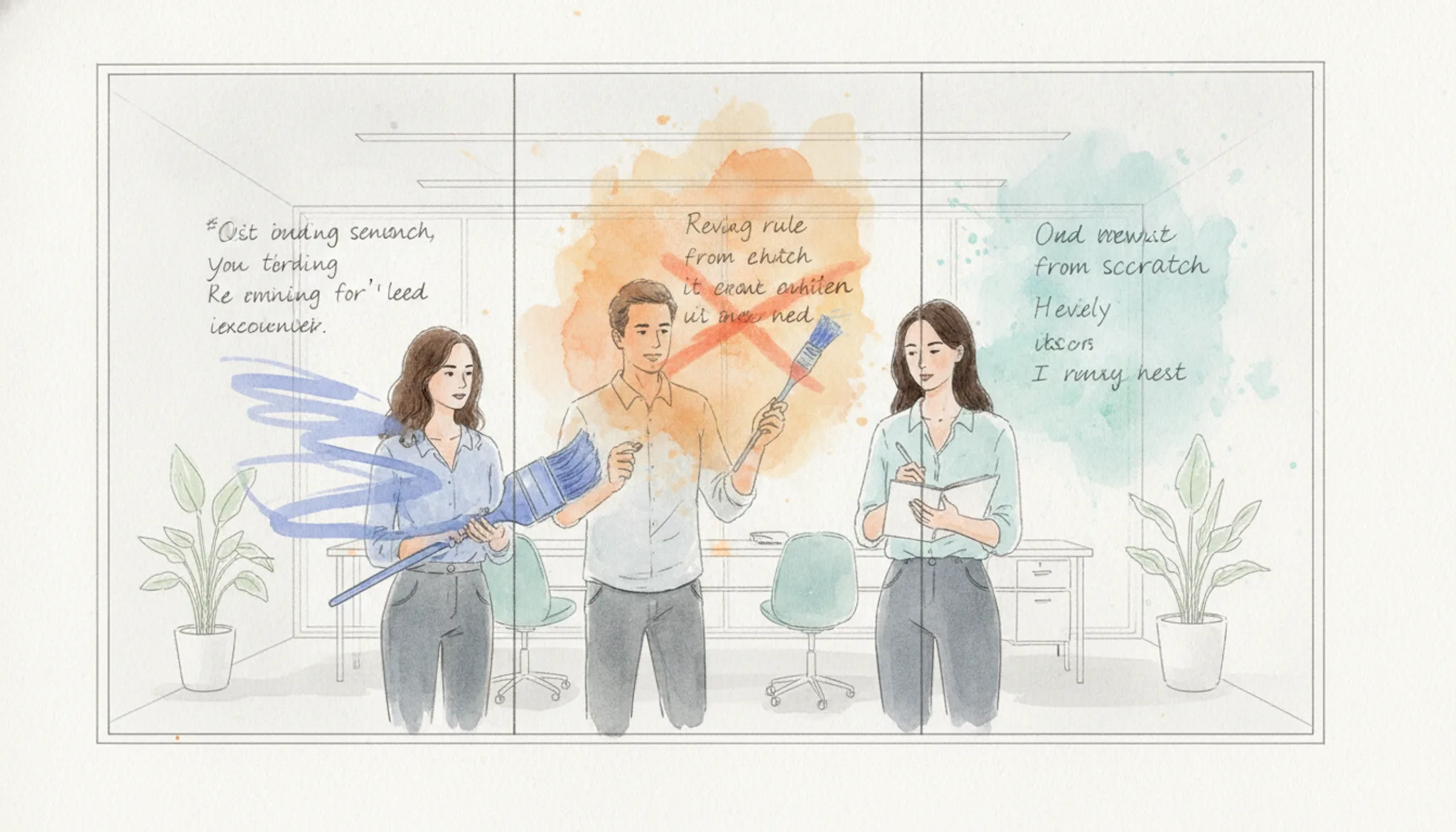
Step 2: Apply the "one-third rule", rewrite every third sentence from scratch
Do not try to polish the whole thing. That takes forever and you will miss the structural patterns. Instead, pick every third sentence and delete it. Then write a replacement sentence that says the same thing in your own voice, shorter, longer, or sideways.
Example:
- Original: "Furthermore, the implementation of this methodology yields significant improvements in overall system performance." Delete it. Replace with: "This method just works better. We saw a 40% drop in latency on the first test."
Notice the replacement has a fragment ("We saw…"), a contraction ("works"), and a specific number. The AI would never write "just works better", that is a human judgment call.
Do this for every third sentence. You will break the AI's rhythm pattern without losing the content. If the text is short (under 10 sentences), rewrite every second sentence instead.
Step 3: Introduce two specific human errors per paragraph
AI text is too correct. It never misspells a word, never uses the wrong homophone, never writes a sentence that could be read two ways. You need to add small, intentional imperfections that a human editor would leave behind.
What works:
- A deliberate comma splice: "The data was clean, we ran the analysis anyway." An AI would write "The data was clean, so we ran the analysis anyway" or split it into two sentences. – A missing article: "We used Python script instead of the full framework." Dropping "a" or "the" in a casual context reads human.
- A slightly mismatched tense: "Yesterday we deploy the fix and it worked." The present tense "deploy" next to past tense "worked" is a classic human editing mistake. – A colloquial word: Replace "utilize" with "use," "demonstrate" with "show," "facilitate" with "help." Then go one step further: replace "help" with "bail out" or "save our butts."
Do not overdo it. One or two per paragraph is enough. The goal is not to make the text sloppy, it is to make it look like a human wrote it quickly and did not obsess over every comma.
Step 4: Break the paragraph structure with a one-sentence paragraph
AI models are trained to produce coherent paragraphs. Humans write one-liners for emphasis, for transitions, or just because they are lazy. Find a point in your text where you can pull a single sentence out and give it its own paragraph.
Before: "The deployment pipeline failed because the configuration file was missing a required field. We fixed it by adding the field and re-running the job. The second attempt completed successfully in under two minutes."
After: "The deployment pipeline failed because the configuration file was missing a required field. We fixed it by adding the field and re-running the job.
The second attempt completed in under two minutes."
That one-sentence paragraph reads like a human saying "and then it just worked." The AI would never break that third sentence out, it is too attached to paragraph coherence.
Step 5: Add a personal aside or opinion that contradicts the main point
AI text is relentlessly on-topic and non-controversial. Insert one sentence per 500 words that expresses a subjective opinion, a doubt, or a tangential thought. This is the hardest thing for AI to mimic because it requires genuine judgment.
Examples:
- "I am still not convinced this approach scales, but it got us through the deadline." – "Honestly, the old system was simpler to maintain, even if it was slower." – "We tried this three times and it failed twice. The third time, we changed nothing and it worked.
Go figure."
These sentences add unpredictability, the surprise factor that AI detectors flag as human. They also make the text more interesting to read.
The AI watermark removal checklist: verify your text is clean
After you run your text through a removal tool, a few invisible characters or awkward phrasings can slip through. Use this checklist to confirm the watermark is gone and the text still reads naturally. Each task is something you can verify in under a minute. If any check fails, go back to the removal tool or manually edit the flagged section.
The goal is not just to pass a detector but to produce text that sounds like you wrote it.
| Task | Why it matters |
|---|---|
| Paste the cleaned text into a Unicode character inspector (like the one at Bramp) | Hidden zero-width spaces, joiners, and directional overrides survive some removals. They are invisible in normal editors but detectable by watermark scanners and can break formatting when you paste into a CMS or PDF export |
| Compare the cleaned version against the original for meaning drift | Aggressive rewrites can change tone, drop key details, or introduce factual errors. A side-by-side diff catches these shifts before you publish |
| Run the text through an AI detector such as Originality or GPTZero | A passing score means statistical watermarks (like SynthID) are likely removed. No detector is perfect, but a low score is a strong signal that the text is clean |
| Check for leftover formatting artifacts: smart quotes, dashes, markdown syntax | These are common ChatGPT and Claude fingerprints that flag text as AI generated even after character removal. A quick find-and-replace can eliminate them |
| Read the text aloud or ask a colleague to review it | Awkward phrasing, repetitive sentence structures, and unnatural transitions often survive automated cleanup. A human ear catches what tools miss |
| Search for common AI filler phrases ("explore", "it is crucial to", "in the current landscape") | These statistical patterns act as watermarks that detectors flag even when invisible characters are gone. Replacing them with your own language removes the fingerprint |
| Verify that the text passes a grammar and style check | Some removal rewrites introduce grammatical errors or awkward phrasing. Running the text through Grammarly or a similar tool catches these issues before you publish |
| Check that the text length did not change drastically | A removal that strips too many characters may indicate over-aggressive cleaning that could affect readability. Compare word counts before and after to spot this |
If you are working on a large batch of text, run the checklist on a sample first. A single pass with a tool like AI Watermark Remover usually handles the invisible characters, but the meaning and style checks are where most mistakes hide. For a detailed breakdown of how one team verified their removal across dozens of documents, read our case study on verifying AI watermark removal.
That case study shows exactly what to look for when a simple clean is not enough and how to catch edge cases like mixed-language text or heavily rewritten passages. The checklist above gives you a repeatable process that works for any AI text source.
Expert tip: strip characters, then rewrite phrasing
> "AI text watermarks are hidden signals embedded in generated text that can identify it as AI-produced." > TextWipes, an AI text watermark remover
The pitfall is stopping once invisible characters are gone. A browser cleaner like AI Watermark Remover strips zero-width spaces and joiners in one pass. The statistical watermark, the word-choice pattern detectors flag, survives untouched. A phrase like "explore" reads as AI even when no hidden characters remain.
So the usual advice changes when a human reads the text: run a second editing pass on formulaic phrasing. To remove AI watermark from text mistakes properly, treat both as separate jobs. Hidden characters are a technical fix; phrasing is an editing fix, and skipping either leaves the watermark half in place.
How to remove a watermark from an image online
For screenshots of AI-generated text, the watermark is often invisible metadata inside the image file, not a visible logo. Removing it online takes three steps.
- Identify the watermark type: Visible logos need a cropping or retouching tool. Invisible markers hide in the file's metadata, which is why the picture looks clean but still carries detectable data.
- Strip the metadata in your browser: Free browser-based cleaners such as AI Watermark Remover process the image locally, removing embedded watermark metadata while leaving the visible pixels unchanged.
- Treat screenshots of AI text separately: If the image is a screenshot, the real watermark is in the wording, so detecting the watermark first is the faster route. For Gemini output, the Gemini text removal guide covers model-specific markers. Paste the extracted text into a cleaner like Simple Unmark to strip hidden characters.
How to remove watermark photoshop?
Removing a visible watermark in Photoshop is straightforward when the background is solid or repetitive. Use the Clone Stamp Tool for the fastest result. Select the tool from the toolbar (shortcut S), then hold Alt and click a clean area near the watermark to set your sample point. Paint over the watermark with a soft brush; the sampled pixels replace the watermark pixels.
For textured backgrounds, the Spot Healing Brush (shortcut J) often works better: just brush over the watermark and Photoshop blends surrounding pixels automatically. If the watermark sits on a busy pattern, switch to Content-Aware Fill: make a selection around the watermark, right-click, and choose "Content-Aware Fill" to let Photoshop reconstruct the area. Each method preserves the rest of the image. For AI-generated text watermarks (invisible Unicode characters), use a dedicated tool like AI Watermark Remover instead.

FAQ
Does rewriting remove the watermark?
It can, when you do it sloppily. Swapping individual words changes tone and precision without breaking the underlying statistical patterns. A better approach is to rephrase whole sentences while keeping the original facts and structure intact. For example, if the original says "The study found a 12 percent increase," you can write "Researchers observed a 12 percent rise."
Same data, new phrasing. That keeps the text accurate and much harder for a detector to associate with the original generation.
The detector still flags my text after I edited it. What did I miss?
Most detectors look for recognizable phrases and repetitive sentence rhythms. If you only changed a few words, the rest has not actually changed. Work through the draft paragraph by paragraph. Read each sentence aloud, then rewrite it as you would say it to a colleague.
Also watch for telltale AI patterns: overuse of "furthermore," perfectly parallel bullet lists, and a final sentence that summarizes the whole thing. Removing those gives you a bigger visible difference than any single word swap.
Does this work for ChatGPT text?
Yes, and ChatGPT text is often the easiest because it tends to use a recognizable formal tone. Replace that tone with your own. Change sentence lengths, mix short statements with longer explanations, and convert generic phrases into concrete details from your own situation. The goal is not to hide the origin, it is to make the text genuinely yours.
Will a detector mark my rewritten text as human?
There is no guarantee. Detectors disagree with each other, and new detection methods appear constantly. The most reliable signal is your own voice. If you write naturally, with specific examples and imperfect rhythm, you are hard to distinguish from any other human writer.
If you try to game a specific detector, you will be back to square one the next time that detector updates.
The final verdict: clean characters first, verify last
Every mistake we covered shares one root cause: invisible characters survive copy-paste, and detectors catch them. Clean hidden characters first, review phrasing second, then verify with a detector. That order catches artifacts that trigger false flags.
AI Watermark Remover is the right default for that first pass. It strips zero-width spaces and joiners from ChatGPT, Claude, Gemini, and Grok output entirely in your browser, and reports how many characters it removed.
Choose differently only when your text needs deep rewriting, not character cleaning. Unmark is the better fit there, since it explicitly rewrites text to defeat statistical watermarks like SynthID. Otherwise, run your next draft through AI Watermark Remover before publishing.