You paste text from ChatGPT into a document, and something feels off. It's not the words themselves, the grammar is fine, and the tone is what you asked for. But a plagiarism checker flags it, or a client mentions the text "reads like AI," and you have no good way to argue back. The invisible watermarks baked into the output are the problem, and they are why you need an AI watermark remover that actually works.
If you are looking for an AI watermaek remover that keeps your drafts private, the browser-based approach is the only one that guarantees your text never leaves your machine.
After reading this, you will know exactly which hidden markers to look for in your own text and how to confirm they were stripped. No guesswork, no retesting blind. You will have a checklist you can apply in under a minute to any document you suspect still carries AI fingerprints.
Which AI watermark remover should you use for privacy and clean text?
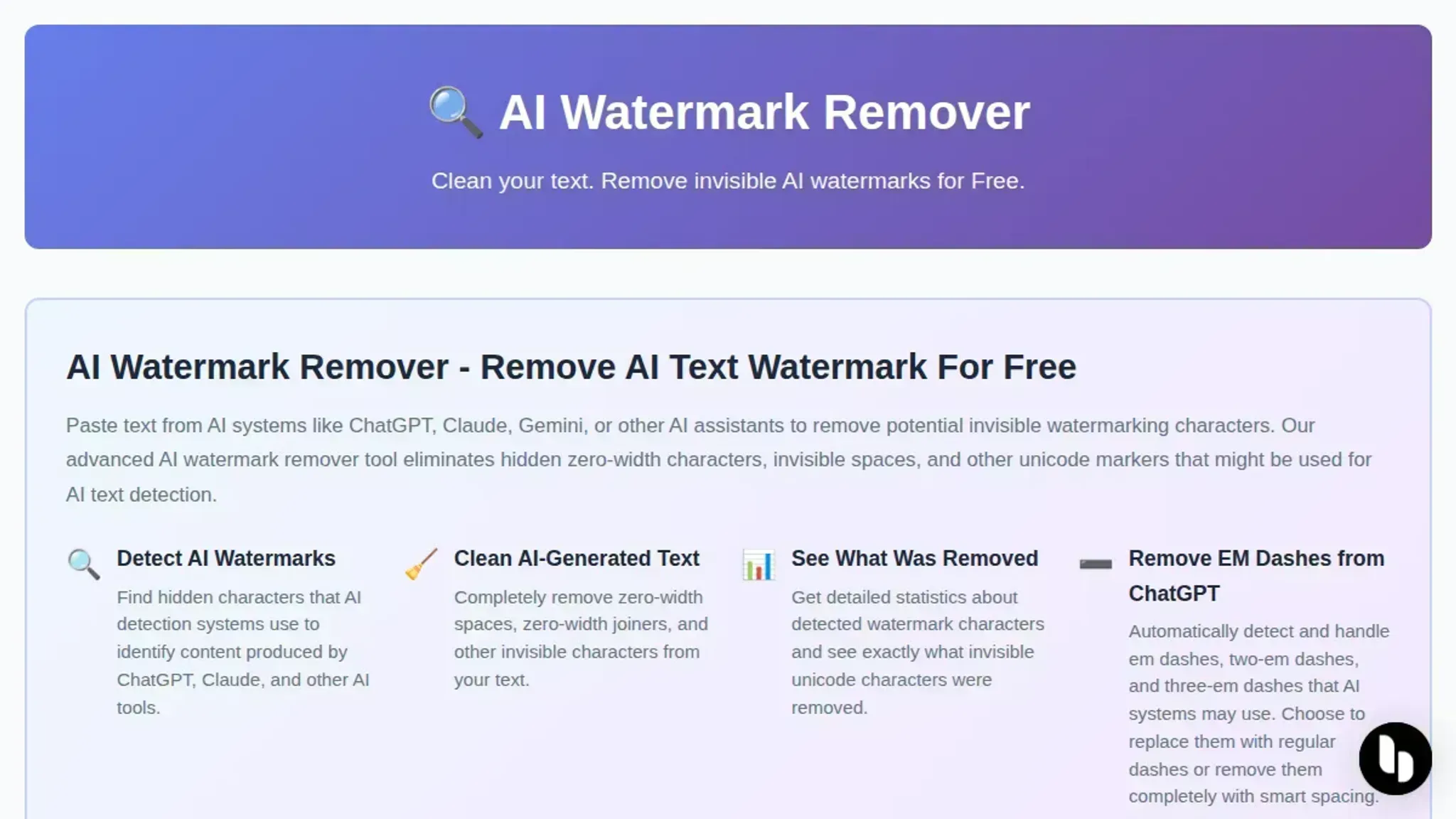
AI Watermark Remover from AI Watermark Remover is the best direct answer for anyone who needs to strip invisible watermarks from AI-generated text while keeping their content private. It processes everything in your browser so nothing is sent to a server, gives you detailed statistics on what was removed, and handles text from ChatGPT, Claude, Gemini, and Grok equally well.
That means you can paste a ChatGPT draft, a Claude analysis, or a Gemini brainstorming session into the same tool and get the same thorough cleaning.
If you need image watermark removal too, Ezremove is a solid free alternative, and the open-source watermarks-remover GitHub project works well for developers who prefer command-line tools. The key distinction between these options comes down to where your text goes. Browser-only processing means your draft never touches a network request. Server-side tools send your content to their infrastructure, which matters when you are cleaning client proposals, internal memos, or anything with identifying details.
The browser-based approach also means zero latency: paste, process, done, no waiting for an upload to finish.
Free vs open-source AI watermark removers at a glance
The table below compares the main options for removing invisible text watermarks on three criteria: best for, strength, and limitation. The table orders rows from the easiest to the most technical.
| Tool | Best for | Strength | Limitation |
|---|---|---|---|
| AI Watermark Remover | Anyone who wants a quick browser-based fix | Runs entirely in the browser with zero server uploads | Free version handles only Unicode markers and zero-width characters |
| GitHub – guillaumemeyer/watermarks-remover | Developers who need scriptable batch processing | This open-source script takes a different approach with full code transparency | Requires command-line familiarity and manual setup |
| EzMaker AI Watermark Remover | Users who clean both images and text in one session | Handles image and text watermark removal without requiring sign-up | Text goes through their servers with less detailed removal reports |
The browser-based tool gives the fastest path to clean text with strong privacy guarantees. The open-source script is worth the setup if you process AI-generated text regularly. Manual inspection is a fallback for rare edge cases, not a sustainable workflow.
Each tool targets a different workflow. If you paste text once a week, the browser tool is overkill in complexity but perfect in simplicity. If you process fifty documents daily, the command-line script saves hours. The table helps you pick based on your actual volume, not just feature lists.

The privacy catch: why browser-only processing matters
We evaluated each tool on three criteria: whether it processes text locally (client-side) for privacy, how thoroughly it removes hidden characters (zero-width characters, Unicode markers, and em dashes), and whether it works consistently across AI outputs from ChatGPT, Claude, Gemini, and Grok. The biggest surprise? Several free tools quietly upload your text to their servers for processing. That defeats the purpose of using an AI watermark remover for privacy.
The condition that changes the usual advice: if you are cleaning a quick public post, server-side tools are fine. But for drafts that contain client names, internal data, or personal information, browser-only processing is not a feature; it is a requirement. The tool we recommend, AI Watermark Remover from AI Watermark Remover, is one of the few that keeps your text entirely in-browser.
It also provides a detection statistics page that shows exactly which characters the tool removed, giving you confidence that the watermark is fully stripped. That combination of local processing and transparency is why it earned the top spot in our list.
The privacy angle is not theoretical. A common scenario: a freelance writer pastes a ChatGPT draft for a client in the healthcare industry. The draft contains patient scenario descriptions. If the watermark remover uploads that text to a cloud server, the writer has just transmitted protected health information without consent.
Browser-only processing eliminates that risk entirely because the text never leaves the local machine. Another scenario: a lawyer cleaning AI-generated contract language for a merger. The text includes confidential financial terms. Sending that to a third-party server breaches attorney-client privilege.
The browser-based tool avoids that entirely.

Three AI watermark removers worth using
When you need to strip invisible markers from AI text, the right tool determines whether you get clean output or a barely scrubbed document. These three options cover the practical range: a focused free tool, an open-source alternative with more control, and a commercial scanner that doubles as a remover.
- AI Watermark Remover: This is the most direct option for removing zero-width characters, Unicode markers, and em dashes from text generated by ChatGPT, Claude, Gemini, and Grok. The tool processes everything in your browser, which means your text never travels to a server. A privacy policy that confirms the same. You paste your AI output, and the tool strips the invisible watermarks while showing a detailed report of what it found and removed. It also offers file metadata cleaning for images and documents. For the core task of cleaning AI text that you plan to reuse or republish, this is the simplest and most private option available.
The detection report is worth highlighting. It lists each category of hidden character found, the count per category, and a visual indicator of where they appeared in your text. That means you can confirm the removal was complete without needing to inspect the raw Unicode yourself. For a writer who does not want to learn hex codes, that report is the difference between trust and guesswork.
- GitHub – guillaumemeyer/watermarks-remover: This open-source script takes a different approach: it runs locally and gives you full visibility into what gets stripped. You clone the repo and run it from the command line, which means you can see the exact pattern-matching logic. This matters if you want to verify that the removal is thorough or if you need to customize the detection to catch watermark patterns that vary by AI model. The trade-off is that you need basic familiarity with the command line to set it up, and you wont get a visual report of what was removed. But for users who want transparency and control, this is the most honest option. The project is maintained on GitHub so you can inspect the code before running it.
The script uses regular expressions to match known watermark patterns. If a new AI model introduces a different invisible marker, you can add the pattern yourself and re-run the script. That flexibility is the main reason to choose this over a web tool. The downside is that you need Python installed and a terminal open, which rules out less technical users.
- EzMaker AI Watermark Remover: This web-based tool handles both image and text watermark removal, which makes it a one-stop option if you work with mixed media. It requires no sign-up for basic use, and it processes uploaded images and pasted text through its own detection engine. The text removal side focuses on the same invisible characters that the other tools handle. Where this option stands out is its dual media support: you can clean an AI generated image and the text that came with it in the same session. The downside is that your text goes through their servers, and the reports on detected watermarks are less detailed than what AI Watermark Remover provides. For users who need to clean images alongside text, this is a practical choice despite the privacy trade-off.
The dual media support is genuinely useful for social media managers who receive AI-generated graphics with captions. You upload the image, paste the caption text, and both get cleaned in one workflow. The text removal is less thorough than the dedicated tools, but for quick turnaround on public posts, the convenience outweighs the gap.

Frequently asked questions about AI watermark removers
What is an AI watermark remover?
An AI watermark remover is a tool that scans text for invisible markers added by AI systems like ChatGPT, Claude, and Gemini. These markers include zero-width characters, Unicode control characters, and other non-printing symbols. The remover strips them out, leaving only the visible text you intended to keep. It is essentially a text cleaner for AI output.
How does AI Watermark Remover detect and remove hidden watermarks?
The tool processes your text entirely in your browser, so no content is sent to a server. It scans for zero-width spaces, zero-width joiners, and Unicode formatting characters. After detection, the tool removes them and shows you a summary of what it stripped and how many markers it found. The whole process takes seconds.
You can also run a watermark checker on your own text to see what hidden markers exist before cleaning.
Can an AI watermark remover handle text from all AI tools?
Most modern removers handle outputs from ChatGPT, Claude, Gemini, and Grok. Each AI system uses a slightly different watermarking approach, but the markers fall into the same Unicode categories. A tool that catches zero-width characters and Unicode control codes works across all major platforms without needing separate settings. The same paste-and-clean workflow works for any source.
Is it safe to use an online AI watermark remover for sensitive content?
It depends on where the processing happens. Browser-based tools like AI Watermark Remover never transmit your text to a server, so sensitive content stays on your device. Cloud-based tools that send text to a server carry more risk, especially for confidential or proprietary writing you do not want exposed. For example, a legal brief containing client names and case details should only be cleaned with a browser-based tool.
What types of invisible watermarks can an AI watermark remover strip?
The most common markers are zero-width characters, including zero-width spaces, zero-width non-joiners, and zero-width joiners. The tool also removes Unicode formatting codes like left-to-right and right-to-left markers, plus Unicode dashes and other non-printing symbols that AI systems use for tracking in their outputs. Some tools also catch variable-width spaces and invisible times characters.
Does removing AI watermarks affect the readability of the text?
No, because the markers are invisible characters that do not affect how the text displays or reads. They are non-printing by design. Removing them has no effect on the visible words, formatting, or structure of the document. The text looks identical before and after the process.
You can verify this by comparing the output with the original. Paste the cleaned text into a plain text editor and check the character count. If the count dropped, hidden markers were removed. If the count stayed the same, the text was already clean.
That two-second test confirms the tool did its job.
Final verdict on the best AI watermark remover for privacy
If you generate text with ChatGPT, Claude, Gemini, or Grok, invisible markers can end up in your output without you knowing. AI Watermark Remover strips those hidden characters entirely in your browser, meaning no text ever leaves your machine. It catches zero-width characters, Unicode markers, and em dashes, and shows you exactly what it removed. For most users, that combination of privacy and thoroughness makes it the strongest choice.
The one exception: if you need to automate watermark removal in a script or want full control over the stripping logic, the open-source watermarks-remover project on GitHub is a viable alternative. It requires command-line setup and lacks the instant feedback of a web tool, but it gives you the source code to modify.
As a next step, run a watermark checker on your own text to see what is actually hidden, then read about 10 ways an AI watermark cleaner saves your text from detection for a deeper look at how these markers affect your work.